Special Exhibitions
Beliefs Are Transformed
By: Tanakrit Polngam
Selected by: Special project’s BACC pop⋅up
Principal Supporter: Seacon Development Co., Ltd.
Thai society, from the past to the present, has long been a space where diverse beliefs coexist. These include Buddhist and Brahmanical traditions, local folk beliefs, and various forms of spirituality, alongside contemporary beliefs shaped by the context of each era. Rather than existing in isolation, these beliefs have gradually intertwined, overlapped, and continuously transformed, creating a condition in which the familiar and the unfamiliar coexist inseparably.
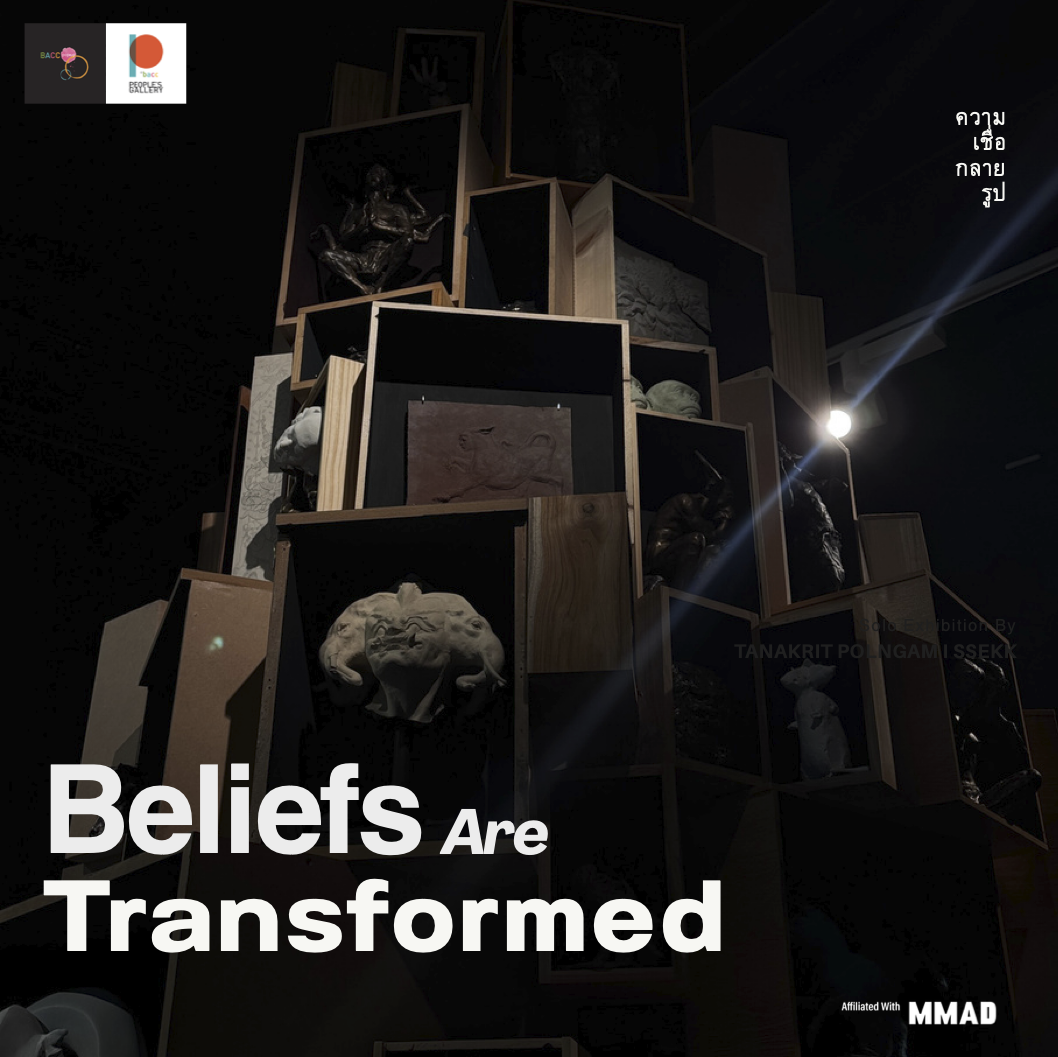
The exhibition “Beliefs Are Transformed” explores the transformation of belief through sculptures created by deconstructing and reassembling forms of humans, animals, mythical creatures, and sacred figures from various cultures. Some forms still retain traces of their original beliefs, while others have been altered into new entities whose origins are no longer clearly identifiable. This results in an in-between state that exists among memory, recognition, and imagination. Each sculpture is placed within a wooden box that functions as a container of layered meanings. These boxes may be perceived as altars, niches for sacred objects, display cabinets, or even everyday storage containers. When multiple boxes are stacked and assembled together, they form structures that resemble architectures of faith, repositories of objects, and spaces of accumulated memory. This reflects how belief in contemporary society no longer exists solely within sacred spaces, but subtly permeates everyday life and contemporary culture.
Rather than presenting a definitive conclusion about belief, the work opens up a space for viewers to contemplate the relationship between faith, memory, and the construction of meaning in contemporary society. As diverse beliefs are continuously merged, reinterpreted, and reconstructed, the question arises: does the sacred still retain its original form and meaning? Or is what is transforming instead the way humans perceive and assign value to these beliefs across different periods of time?
Image Gallery