Main Exhibition
Undo Planet Part 2
Organised by Bangkok Art and Culture Centre, the Bangkok Metropolitan Administration, and in collaboration with Space for Contemporary Art and Korean Foundation for International Cultural Exchange
Principal Corporate Supporter: Thai Beverage Public Company Limited
Project Supporters: The Korean Ministry of Culture, Sports and Tourism and Real DMZ Project
Media Partners : ONCE, Room Books, KiNdconnext
Curated by Sunjung Kim
Artists
Asunción Molinos Gordo
Ampannee Satoh
Belén Rodríguez
Dane Mitchell
Hashel Al Lamki
Jane Jin Kaisen
Nancy Holt
Rim Dongsik
Robert Smithson
Shimabuku
SIDE CORE
Simon Boudvin
Tuan Mami
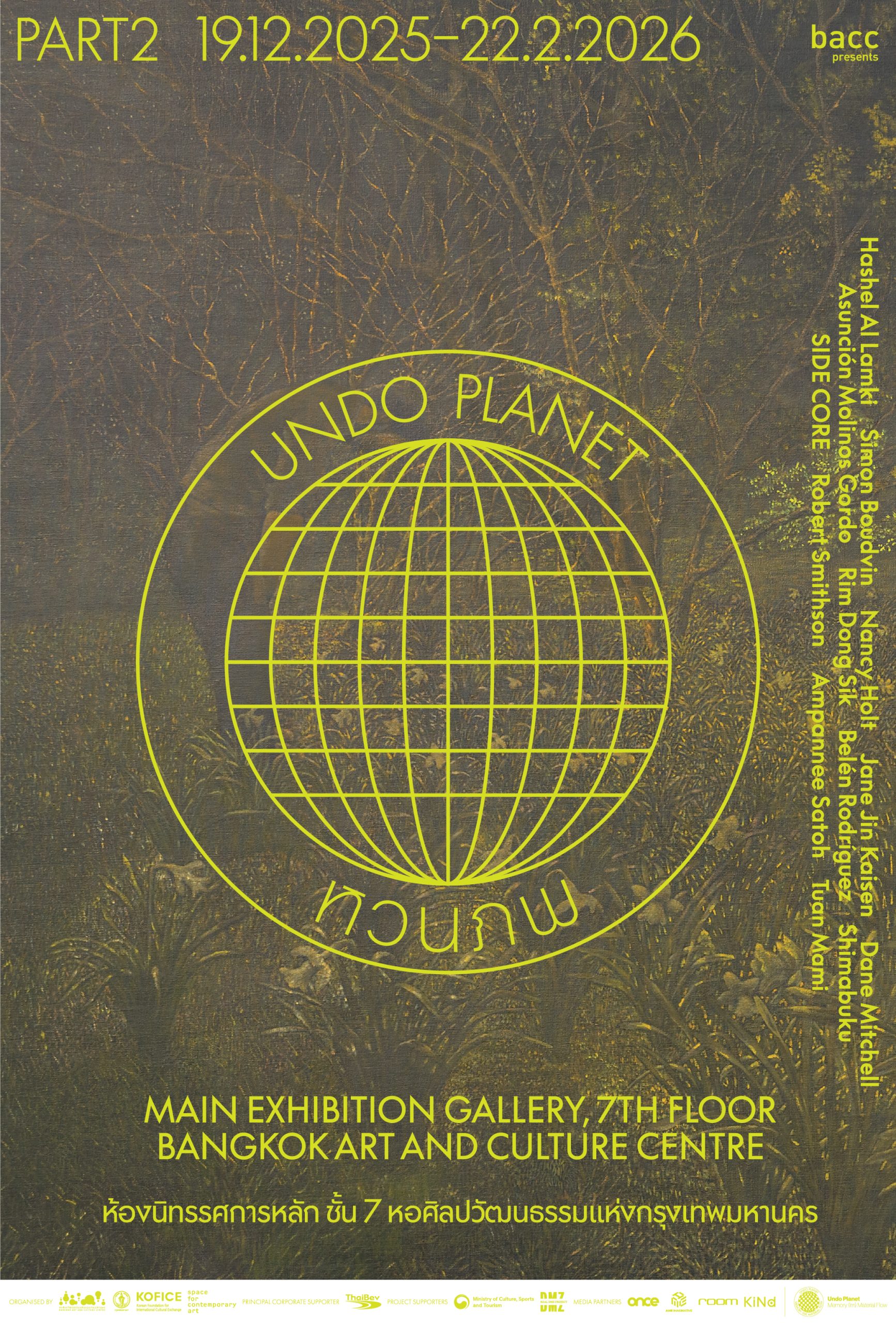
Undo Planet Part 2
Bangkok Art and Culture Centre, in collaboration with Space for Contemporary Art and Korean Foundation for International Cultural Exchange, co-organises an international exhibition, Undo Planet. The exhibition Undo Planet uses art as a medium to examine possibilities for restoring nature. The artists join in wrestling with the issue of global climate change, offering various attempts and suggestions as to how our crisis-stricken Earth might be restored which consists of two parts: Undo DMZ and Land Art and Non-Human Beings.
The Earth consists of various components, including the land, the seas, and plant and animal life. Rather than coexisting with them, human beings have objectified and dominated nature based on anthropocentric thinking. Nature has been viewed as something to be overcome, and the process of pursuing convenience has left the global environment faced with crisis. The second part of this exhibition examines nature as something to coexist with rather than something that must be overcome, as it explores the imagination of artists and various forms of practice to undo the damage done to nature.
The second section, “Land Art and Non-Human Beings,” begins with works by major figures in land art: Spiral Jetty [film] (1970), a defining work by Robert Smithson, and Sun Tunnels [film] (1978) by Nancy Holt. Spiral Jetty [film] uses aerial photography to document a spiral structure formed out of granite, mud, and salt crystals, measuring 4.6 meters across and stretching to a length of 457 meters. Smithson’s voice alludes to the ideas that inspired his work, as well as its creation process and prehistoric relics, spaces, scales, and landscapes. Holt’s Sun Tunnels [film] is a video record of a site-specific sculpture in the northwestern desert of Utah. Its four concrete tunnels measure roughly 2.4 meters in length and 2.7 meters in diameter, with positions based on the sunrise and sunset during the summer and winter solstices. Holes are bored into them to allow light to filter in the shape of constellations. The video shows images of the sun and light observed through the tunnel as they transform during the summer and winter solstices.
Mami’s Borderless Garden (no.2), first presented in Part 1, continues to be exhibited in Part 2. A work of wall art inspired by Korea’s foundational Dangun myth expands this legendary narrative of an animal’s human transformation into linkages between plants, animals, and people. This serves a mediating role in terms of the overall exhibition, as it leads into the second part.
Shimabuku presents photographs, slideshows and video of land art such as Erect (2017), which was created with wood and stones gathered from coastal regions ravaged by the Tohoku Earthquake in Japan; Necklace: Carrying Stones up the Mountain (2021), an installation work in which stones from Okinawa, Setouchi, and Hokkaido are taken to a mountain and arranged in a circular shape; The White Road (2019), in which white stones were used to create a road leading from the sea to the sky; and Snowman Honeymoon (2023), in which snowmen are positioned on a bed in a no-longer-operational hotel. Another of his works, Swan Goes to the Sea (2012 & 2014)portrays a journey in which he takes a swan-shaped pedal boat from his childhood memories out to the sea, exploring the encounter between human-made artefacts and nature.
Asunción Molinos Gordo summons the forgotten wisdom of our ancestors, with her video work Barruntaremos (Inklings) (2021) focusing on ancient weather forecasting methods that are still used in regions of Spain, Latin America, the Caribbean, and Africa. This work suggests how traditional wisdom could offer a tool for overcoming the climate crisis. Belén Rodríguez presents Chaqueta de granjero (Farmer’s Jacket) (2024), which photographically presents natural landscapes that the artist herself has restored and cared for. Simon Boudvin’s Vulpes Vulpes Bruxellae (2024) explores the coexistence of species and the hybrid nature of urban ecology as it assembles video footage taken by citizens showing wild foxes living in urban settings.
Hashel Al Lamki’s work Orphalese (2024) was inspired by the tents used by Bedouins in the deserts of the Arabian Peninsula. Combining traditional painting with batik dyeing and sculpture, this is a contemporary art-based reinterpretation of the traditional wisdom used to persevere against the hot winds and sandstorms of the desert. Dane Mitchell’s Ambergris (Capture and Dispersal) (2024) adopts the theme of ambergris, which for centuries has been a prized material in the scent industry. Using two air-conditioning lift devices, it distributes synthetic scent from one side and actual distilled ambergris from the other. In this way, it blurs the boundaries between the natural substance and a human-made synthesis of it, illustrating the inseparability of the natural and artificial in late capitalism.
Rim Dongsik’s Greetings to Bowing Flowers (2005) is a painting depicting a performance in a field of daffodils near the artist’s studio. A practitioner of naturalist art who has long lived in Korea’s provinces, Rim created a work that offers a sense of the warmth of nature with almost no use of oils, as a brush was used to apply paint as if applying dots. Alongside the painting, the exhibition also presents a range of archival materials, including records of his performances, photographs, and idea sketches. Jane Jin Kaisen’s Invocation (2019) is a video work that follows a spinning body, capturing the moment when a human becomes connected to Jeju’s volcanic landscape. As the camera rises into the air and the body is reduced to a small point within the terrain, the viewer senses humans as integral parts of nature. Focusing on the connections between human beings and nature and between tradition and the present, her work reflects on life, death, and the coexistence of nature and human beings.
SIDE CORE presents new land (2024), a performance- and video-based reconstruction of the transformation of a portion of sea into land by coastal uplift resulting from an earthquake on January 1, 2024. Ampannee Satoh’s Lost Motherland (2016/2025) is a video and photographic work that explores the relationship between humans and place, addressing the sense of loss experienced by migrants and reflecting on the histories and memories embedded in those lands.
This exhibition was supported by the Korean Ministry of Culture, Sports and Tourism, and Korean Foundation for International Cultural Exchange (KOFICE) as part of the “Touring K-Arts” project.
Image Gallery